The Best Inflation Hedge
6
min. read
Of all the ways to protect wealth from inflation, one has consistently grown purchasing power for more than a century.
The reason is simpler, and more powerful, than most people realize.
We believe owning great companies is the most reliable and effortless way to build wealth and sustain throughout generations.
Through your portfolio, you own the greatest companies in America and across the globe. These are businesses that feed us, power our homes, develop lifesaving medicines, and build the technology we rely on every day.
They aren't simply investments on a statement. They are productive businesses creating real value.
Warren Buffett illustrated this distinction with a striking comparison. In 2012, all the gold in the world, a cube measuring roughly 68 feet on each side, was worth approximately $9.6 trillion. For that same amount, you could have purchased every acre of U.S. cropland, 16 Exxon Mobils, and still had about $1 trillion left over.
A century later, the gold would still be the same 68 sq ft cube. Meanwhile, the farmland would have produced 100 years of harvests, and the businesses would have generated decades of earnings and dividends.
That's the difference between owning something valuable and owning something that creates value.
Buffett has been equally direct about cash and bonds. Both serve important purposes, particularly for liquidity, stability, and near-term spending needs. But over long periods, inflation will quietly erode their purchasing power.
Every investment carries risk. With great companies, that risk includes temporary declines in market value. With cash and fixed payments, it's the gradual loss of what those dollars can buy.
Consider the last century. Since 1928, consumer prices have risen approximately 18x. A dollar from that year now buys only about a nickel's worth of goods and services.
Over that same period, $100 invested in Treasury bills grew to roughly $2,578. Gold, even after its strong performance in recent years, turned $1 into approximately $21,025. But that same dollar invested in U.S. stocks grew to roughly $1.1M.
.png)
The difference is extraordinary.
And while real estate can certainly build wealth, its true returns must account for maintenance, taxes, insurance, transaction costs, and the risks that come with leverage.
What makes businesses different? It comes down to something no other asset can replicate quite the same way: human ingenuity.
Behind every great company are people finding better, faster, and more efficient ways to solve problems and meet human needs.
A century ago, America's leading businesses built railroads and produced steel. Today, they develop software, manufacture semiconductors, and create medicines that transform lives.
The industries change, but the engine of progress remains the same.
A diversified portfolio allows you to participate in that progress, evolving alongside the economy as tomorrow's leaders emerge and yesterday's fade.
And that ability to adapt is especially valuable when it comes to inflation.
Inflation, or rising prices, is the quiet risk most people underestimate. For a retiree today, just 3% annual inflation means living costs are two and a half times higher by end of a 30-year retirement. For example, a $100k lifestyle at age 65 will be $250k per year by age 95.
Businesses are often the ones setting those prices.
When the cost of groceries, energy, or healthcare increases, companies with strong competitive positions adjust what they charge to help offset higher costs.
For a fixed dollar, inflation is a headwind. For a great business, it is an opportunity to grow revenue and earnings over time.
That growth ultimately finds its way back to shareholders.
Since 1979, dividends paid by S&P 500 companies have grown approximately 14x, while consumer prices have roughly quadrupled. Dividend growth has significantly outpaced inflation, helping investors maintain and grow their purchasing power.
Think of it as the potential for a growing stream of income throughout retirement, with benefits that extend to your children and grandchildren.
Of course, those benefits become even more powerful when you give them time to compound.
Would you rather have $1 million today or a penny that doubles every day for 30 days?
At first, the penny seems like a terrible choice.
On day 15, it's worth just $163.84. By day 20, it's grown to $5,242.88.
But by day 30, that penny has become $5,368,709. And remarkably, half of that growth occurs on the final day.
That's the power of compounding.
Great companies don't double in value every day, but the principle is the same. At an annual return of approximately 7% after inflation, your purchasing power would double roughly every 10 years.
The greatest rewards often come not from predicting the next market move, but from allowing compounding to work uninterrupted over decades.
Of course, staying invested is easier said than done.
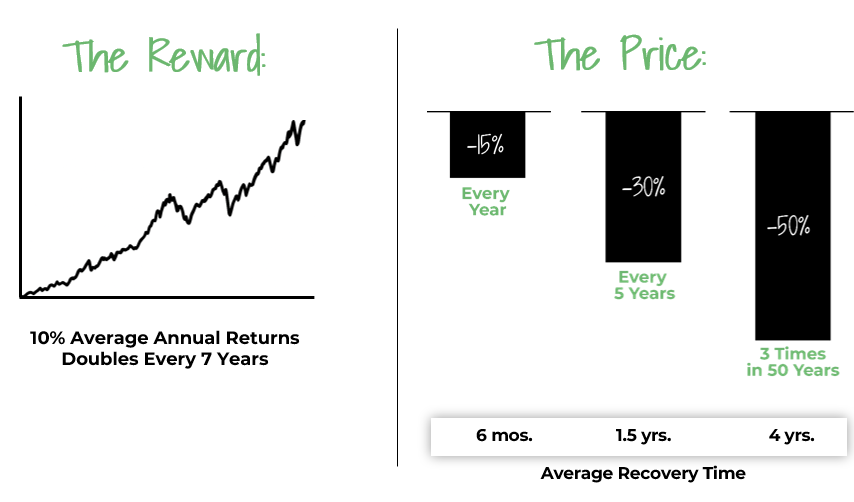
Even the greatest businesses experience periods when their market values fall, sometimes sharply.
There have been 3 declines of about 50% since 1973, and the longest it took stocks to recover (with dividends reinvested) was about 5 years and 8 months (2000 to 2006). So even something that bad is still temporary.
History has shown that broad U.S. stock market declines have eventually given way to recoveries and new highs, although the timing is never certain and future recoveries are not guaranteed.
These declines are uncomfortable, but they are part of the price investors pay for the opportunity to earn long-term returns that outpace inflation.
The key is recognizing the difference between a temporary decline in market value and a permanent loss of purchasing power.
One can test your patience. The other can quietly undermine your financial future.
And that brings us to perhaps the most important ingredient in long-term investing: optimism.
Owning great companies is ultimately a belief that the future will be better than the present.
It's a belief in innovation, productivity, entrepreneurship, and the ability of people to solve problems that once seemed impossible.
Throughout history, that belief has been rewarded over long periods, even through wars, recessions, inflation, and countless moments of uncertainty.
Pessimism often sounds more convincing in the moment. There's always a reason to worry, and there always will be.
But progress rarely makes headlines the way fear does.
The greatest risk to a family's long-term wealth isn't necessarily a temporary market decline. It's reaching the future with money that no longer buys what it needs to.
Great businesses offer something uniquely powerful: the ability not just to preserve wealth, but to grow its purchasing power over time, for you and for the generations that follow.
We don't try to forecast markets. We focus on owning great businesses for the long term.
Because the goal isn't simply to accumulate more dollars. It's to grow what those dollars can buy, so your wealth continues to support the life you want to live and the legacy you hope to leave.
If you have questions about what you own or how your portfolio is positioned to protect against inflation, give us a call anytime.
We're always happy to talk.
